Loading... Please wait...


- Home
- Yoga
- MASTERS OF YOGA & MEDITATION
- MASTERS OF YOGA (T - Z)
- Vivekananda
- Raja Yoga Or Conquering the Internal Nature
Categories



Raja Yoga Or Conquering the Internal Nature

Product Description
Conquering the Internal Nature
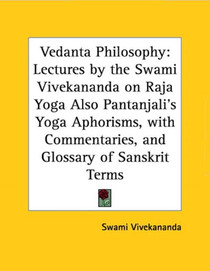
The subject of the present book is that form of Yoga known as Raja Yoga.
The aphorisms of Patanjali are the highest authority and text book on Raja Yoga. The other philosophers, though occasionally differing from Patanjali in some philosophical aspect, have, as a rule, acceded to his method of practice a decided consent. The first part of this book is comprised of several lectures to classes delivered by the present writer in New York.
The second part is a rather free translation of the aphorisms (Sutras) of Patanjali, with a running commentary. Effort has been made to avoid technicalities as far as possible, and to keep to the free and easy style of conversation. In the first part some simple and specific directions are given for the student who wants to practise, but all such are especially and earnestly reminded that, with few exceptions, Yoga can only be safely learned by direct contact with a teacher.
If these conversations succeed in awakening a desire for further information on the subject, the teacher will not be wanting.
Dimensions: 11.0" x 8.25"
Details: Paperback, 100 pages
Author: Vivekananda
About Vivekananda
A spiritual genius of commanding intellect and power, Vivekananda crammed immense labor and achievement into his short life, 1863-1902. Born in the Datta family of Calcutta, the youthful Vivekananda embraced the agnostic philosophies of the Western mind along with the worship of science.
At the same time, vehement in his desire to know the truth about God, he questioned people of holy reputation, asking them if they had seen God. He found such a person in Sri Ramakrishna, who became his master, allayed his doubts, gave him God vision, and transformed him into sage and prophet with authority to teach.
After Sri Ramakrishna's death, Vivekananda renounced the world and criss-crossed India as a wandering monk. His mounting compassion for India's people drove him to seek their material help from the West. Accepting an opportunity to represent Hinduism at Chicago's Parliament of Religions in 1893, Vivekananda won instant celebrity in America and a ready forum for his spiritual teaching.
For three years he spread the Vedanta philosophy and religion in America and England and then returned to India to found the Ramakrishna Math and Mission. Exhorting his nation to spiritual greatness, he wakened India to a new national consciousness. He died July 4, 1902, after a second, much shorter sojourn in the West. His lectures and writings have been gathered into nine volumes.Custom Tab
Returns Policy
Your satisfaction is extremely important to us. If, for any reason, you are not satisfied with an item you ordered from us, you can return it for a full reimbursement - minus any re-stocking fees (see below), any time within 30 days of your receipt of an item. We'll also refund the shipping cost if the return is a result of our error. We cannot reimburse your shipping costs for any item that is returned at your discretion. Here are the general guidelines for returning products:
All items must be in their original, new, condition.
CD's, VHS tapes, audio books, and DVD's must by unopened, unless they are defective.
There is up to a 15% re-stocking fee for returned items - depending on the item. Many items do not have a re-stocking fee. Our distributors charge this fee, not us.
Note: Please call us toll free at 866.665.7765 Monday - Sunday 9 am - 6pm PST, or email us for an RMA# BEFORE returning any items.
Items shipped directly from the manufacturer or a distributor may need to be returned directly to the manufacturer or distributor, and NOT to us. Therefore please call us before returning any items.
We will notify you via e-mail of your refund once we've received and processed the returned item. You can expect a refund in the same form of payment originally used for purchase within 7 to 14 business days of our receiving your return. If your return is not due to our error, the refund will not include shipping costs.
Shipping
Shipping within the United States
You will receive a confirmation of your order via e-mail, usually within 15 minutes. Please make sure that your email spam program is set to receive emails from "@innerpath.com". If you do not receive an order confirmation within 15 minutes, please also check your junk mail folder. Orders are usually shipped within 2-3 business days. In the United States we ship U.S. Postal Service Priority Mail or United Parcel Service. Please note that items in your order may ship separately from different locations. So allow sufficient time for all parts of your order to arrive. If you have any questions or concerns about where an order might be, please call us at 866.665.7765 Monday - Sunday 9 am - 6pm PST, or email us. We will be more than happy to assist you.
Shipping outside the United States
For overseas and Canadian shipping, please check "Email Me My International Shipping Quote $0.00". We will then email you the options for shipping to your country. You then email us back to let us know which method you would prefer, and at that time we will ship your order and charge your credit card. Please note: If you select a shipping method that is not insured, after we ship it from the US we have no control over what the postal service in your country will do. Therefore, unfortunately we cannot be responsible for lost packages that were not sent by insured post. If you need phone assistance please call us at 530.470.6057 Monday - Sunday 9 am - 6pm PST.